Why Are Process Control Systems Important for Buyers?
A process line rarely announces a problem politely. A drifting temperature, delayed valve, or noisy sensor can quietly affect product quality, energy use, and output. That is why buyers should evaluate process control systems as operating infrastructure, not merely as software or instrumentation.
Market reports underline the growing investment in automation. Grand View Research estimated the global process automation market at $106.2 billion in 2022, with projected growth through 2030. Deloitte’s 2024 smart manufacturing survey also found that 86% of surveyed manufacturing executives viewed smart factory solutions as important future competitiveness drivers. These figures describe broad markets and expectations; they do not guarantee savings at any particular plant. Buyers still need evidence from comparable applications.
The technical case is practical. A well-matched system can help operators monitor process variables, respond to deviations, and keep equipment within defined operating limits. It can also make alarms and performance data easier to interpret during a busy shift. But integration, staff training, cybersecurity, and long-term support deserve equal attention. A polished dashboard cannot fix poor sensor placement.
As statistician and quality-control expert George E. P. Box wrote, “All models are wrong, but some are useful.” His reminder applies to control strategies: simulations inform decisions, but plant conditions test them. Buyers should ask for documented performance, realistic commissioning plans, and clear ownership of maintenance. No system removes uncertainty. The goal is to manage it better.
How Process Control Systems Monitor and Regulate Industrial Processes
A process control system turns measurements into operating decisions.
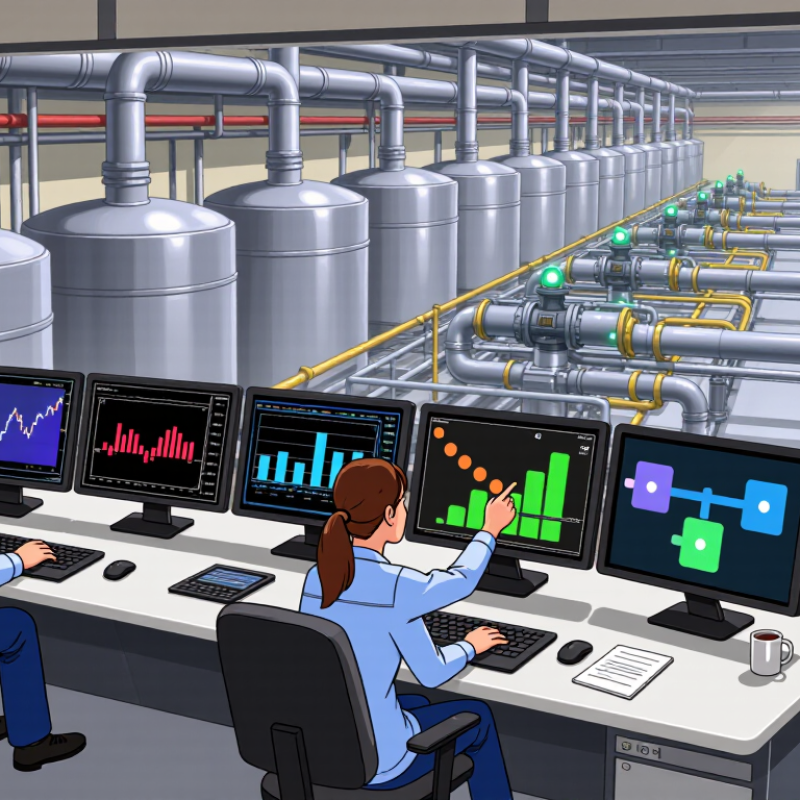
Sensors track variables such as temperature, pressure, flow, and tank level. A controller compares each reading with its target, then adjusts valves, pumps, or heaters. For example, a flow sensor may detect a falling feed rate. The controller can open a valve before the downstream vessel runs short. Small corrections help keep production steady.
The stakes are substantial. The International Energy Agency’s Tracking Clean Energy Progress 2023 report estimates that industry uses about 37% of global energy. Control systems help operators spot energy waste, unstable conditions, and equipment drift. Deloitte’s 2023 Smart Manufacturing Survey found that 86% of surveyed executives expect smart manufacturing to be a primary driver of competitiveness within five years. That figure reflects executive expectations, not a guaranteed result. Buyers should look for systems that make measurements visible and actions traceable.
A screen can look reassuring. It can still be wrong. Sensors drift, instruments need calibration, and poor alarm settings can hide real changes. Buyers should ask how quickly the system detects deviations, how operators review historical trends, and what happens when a sensor fails. Test these details against actual operating conditions, not only a supplier demonstration. A well-configured system supports human judgment; it does not replace it.
Key Components Buyers Should Understand
Why Are Process Control Systems Important for Buyers?
Key Components Buyers Should Understand
A process control system is more than a controller in a cabinet. Buyers should assess the full chain: sensors measure variables such as pressure, flow, and temperature; controllers interpret those signals; and actuators move valves or adjust motors. Human-machine interfaces show operators what is happening, while supervisory systems help track trends across a plant. Each part must communicate reliably. A temperature sensor that drifts can quietly distort every decision downstream.
Ask how the system handles failure, expansion, and maintenance. Check measurement ranges, response times, spare-part availability, and compatibility with existing equipment. The International Energy Agency’s Energy Efficiency 2023 report notes that industry accounts for about 37% of global energy use. Better measurement and control can support efficiency, but results depend on sound commissioning and ongoing calibration—not software alone. NIST’s Guide to Operational Technology Security, SP 800-82 Rev. 3, also recommends managing OT risks while preserving safety and reliability. Integration deserves close scrutiny. It is often underestimated.
Tips: Request a sample control narrative and an input/output list before purchase. Confirm who owns configuration backups, alarm settings, and operator training. Ask for a failure-response demonstration, not just a polished screen tour. Small details matter: a valve’s fail position, a sensor’s calibration interval, or an unclear alarm can change how a shift responds. Buyers should document assumptions; some will need revisiting after the first months of operation.
How Control Systems Affect Safety, Quality, and Efficiency
For buyers, process control is the difference between a setpoint on paper and a stable temperature, pressure, or flow on the production floor. Sensors, alarms, and interlocks help operators spot deviations before they become unsafe conditions or rejected batches. The ILO and WHO estimated 1.9 million deaths from work-related diseases and injuries in 2016. That figure covers all industries, not control systems alone, but it underlines why dependable monitoring matters. Small drifts matter. A poorly placed sensor can still miss a hot spot, so buyers should assess sensor coverage, alarm clarity, and maintenance needs—not just the control panel.
Quality and efficiency depend on repeatable process conditions. A control system can log each batch’s temperature curve, flag out-of-range readings, and help teams trace defects to a specific shift or machine. It cannot replace skilled operators or sound procedures. Not a guarantee. The U.S. Department of Energy’s 2022 Industrial Decarbonization Roadmap reports that industry accounts for about 30% of U.S. primary energy use and energy-related carbon emissions. Better monitoring and tighter control can help limit wasted heat, compressed air, or raw material, though results depend on the process and upkeep. Buyers should ask for evidence from comparable installations, including downtime, scrap, and energy records; attractive dashboard graphics alone prove little.
Why Process Control Systems Matter to Buyers
Illustrative example only: higher percentages indicate more favorable results for each operational indicator. Actual performance varies by process, equipment, and operating conditions. Track safety, quality, and efficiency KPIs at your facility when evaluating a control system.
Factors Buyers Should Evaluate Before Choosing a System
A process control system should match the work, not just the specification sheet. Buyers should map the key variables, operating ranges, and consequences of a control failure before comparing options. Evaluate whether the system can handle routine changes, such as a new sensor or a wider production range, without major redesign. Ask how it responds to noisy readings, communication loss, and sudden process changes. Test the edge cases. A live demonstration using realistic operating data is more useful than a polished presentation. Still, no demonstration can reproduce every shift condition.
Check compatibility with existing equipment, data systems, and maintenance skills. Review alarm handling: operators need clear priorities, not a screen crowded with warnings. Ask about access controls, backup and recovery procedures, and how system changes are documented. Calculate lifecycle costs, including training, integration, spare parts, and future upgrades. Request evidence of reliability and support response times, rather than relying on broad assurances. A clear interface matters, but it is not the whole story. Buyers sometimes overvalue feature lists and undervalue daily workflow. That trade-off deserves a second look. Compare systems against a short, written set of operating needs, and record where each option falls short.
Lifecycle Costs, Integration, and Long-Term Support Considerations
A process control system can look affordable on a quotation and become costly over time. Buyers should compare the full lifecycle cost, not just hardware and installation. Include engineering hours, operator training, calibration, software updates, spare parts, and planned downtime. Small expenses add up. For example, a sensor that needs frequent recalibration can consume maintenance hours long after commissioning. Ask suppliers to explain what their estimates exclude. Cost forecasts are useful, but they can still miss site-specific complications.
Integration deserves equal attention. Check whether the system can exchange data with existing controllers, safety equipment, and plant historians. A compatibility claim is not enough; request a documented interface list and test plan. During a site review, trace a real signal from a field device to the operator display. That simple exercise can expose missing tags or conversion work. Older equipment may behave unpredictably. No checklist catches everything.
Long-term support affects reliability and staffing. Confirm how quickly technical help is available, how spare parts are sourced, and how updates are tested before deployment. Ask whether system documentation includes configuration records, alarm settings, and recovery procedures. These details help plant teams diagnose faults without waiting for outside assistance. Support promises should be measurable, not vague. Buyers should also consider whether internal staff can maintain the system after specialist contractors leave. That question is easy to overlook.